Brixus
  1. Courses
  2. Certification Study Guides
  3. DP-900 Azure Data Fundamentals Study Guide & Exam Questions
  4. Read
DP-900 Azure Data Fundamentals Study Guide & Exam Questions
  • 1.Part 1: Core Data Concepts and Workloads
    • 1. Structured, Semi-Structured and Unstructured Data
    • 2. Data Roles: Engineer, Analyst and Scientist
  • 2.Part 2: Relational Data on Azure
  • 3.Part 3: Non-Relational Data on Azure
  • 4.Part 4: Analytics Workloads on Azure

Your progress is not saved. You are trying this lesson as a guest, so your answers and progress are not saved.

1.1 Structured, Semi-Structured and Unstructured Data

Data powers digital transformation across organizations and society. At its simplest, data is a collection of facts — numbers, descriptions, and observations — used to record information, and data solutions provide the software and platforms to collect, store, and analyze it.

Over recent decades the volume created by systems, applications, and devices has grown sharply. Collection is easier and storage is cheaper, so almost every business can use data as a valuable asset to grow revenue, increase profit, and inform critical decisions. Capturing, storing, and analyzing data is now a core requirement, built on choices about representation, storage, and workload type.

Different people prefer different formats. Video presentations give an overview while written text provides greater detail, so text can be used as supplemental material to video.

Watch the video

Three formats of data

Data is often organized around entities important to a business, such as customers, products, and sales orders. Each entity has attributes or characteristics, for example a customer name, address, and phone number. The organization of those attributes falls into structured, semi-structured, and unstructured data.

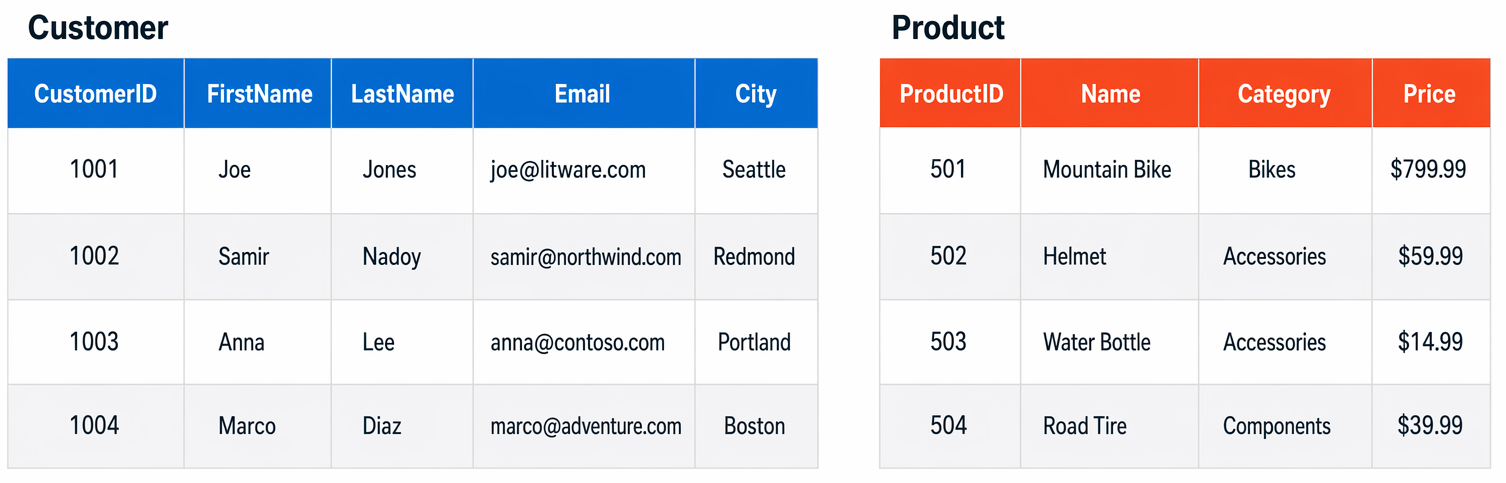
Structured data follows a fixed schema where every instance has the same fields. It is usually tabular: each row represents one instance of an entity and each column represents an attribute. Customer and Product tables are typical examples, with columns such as customer ID, name, and city.

Structured customer and product data shown as tables with rows and columns

Tables for structured data are often linked through key values in a relational model, where multiple tables reference one another.

Semi-structured data has some structure but allows variation between instances. Most customers may have an email address, yet some have several addresses and some have none. JavaScript Object Notation (JSON) is a common representation, using hierarchical objects with differing fields per document.

// Customer 1
{
  "firstName": "Joe",
  "lastName": "Jones",
  "address":
  {
    "streetAddress": "1 Main St.",
    "city": "New York",
    "state": "NY",
    "postalCode": "10099"
  },
  "contact":
  [
    {
      "type": "home",
      "number": "555 123-1234"
    },
    {
      "type": "email",
      "address": "joe@litware.com"
    }
  ]
}

// Customer 2
{
  "firstName": "Samir",
  "lastName": "Nadoy",
  "address":
  {
    "streetAddress": "123 Elm Pl.",
    "unit": "500",
    "city": "Seattle",
    "state": "WA",
    "postalCode": "98999"
  },
  "contact":
  [
    {
      "type": "email",
      "address": "samir@northwind.com"
    }
  ]
}
Note

JSON is only one of many ways to express semi-structured data. The lesson is its flexibility, not JSON syntax itself.

Unstructured data has no preset tabular or hierarchical structure, including documents, images, audio, video, and binary files. Organizations increasingly convert this content into vector data, also called embeddings: numeric series produced by an embedding model. For example, a Word document, PDF file, image, sound wave, and video file on the left are passed through a blue arrow representing the embedding model to produce series of numbers on the right. A graph of semantic similarity against data points shows that vectors preserve meaning, which lets AI assistants answer questions over an organization's own documents and data.

Diagram: Unstructured data, Word document, PDF file, Image photo, Audio waveform, Video file, Vector data (embeddings), Vectors: 0.12, -0.34, 0.87, Similar meanings stay close, Embedding model

1. A university registrar stores every student with the same columns for ID, name, and enrollment year in a table. Why is this structured data rather than semi-structured data?
  • It allows each record to have different fields
  • It uses a fixed schema with the same fields for every record
  • It stores only images and video
  • It stores only numeric vectors
Show answer and explanation
  • It uses a fixed schema with the same fields for every record

Structured data uses a fixed tabular schema with the same columns for every row, while semi-structured data allows fields to vary between instances.
2. Vector data enables AI assistants to answer questions over an organization's own documents by representing unstructured content as numbers that preserve meaning.
  • True
  • False
Show answer and explanation
  • True

Embeddings are numeric vector representations that capture semantic similarity so AI assistants can search and answer over documents, images, and audio.

3. Match each university data example to its data format.
  • All products share identical ID, name, and price columns
  • One customer has two contacts, another has one, another has none
  • A collection of photos, PDFs, and video clips with no common fields
  • semi-structured data
  • structured data
  • unstructured data
Show answer and explanation
  • All products share identical ID, name, and price columns: structured data
  • One customer has two contacts, another has one, another has none: semi-structured data
  • A collection of photos, PDFs, and video clips with no common fields: unstructured data

Fixed-schema rows and columns define structured data.

Varying fields per instance define semi-structured data.

Lack of preset structure defines unstructured data.

Where data lives: files and databases

Stored data records entities such as customers and products, events such as sales transactions, and content such as documents and images for later retrieval and analysis. Two broad categories of store are in common use: file stores and databases, explored in the following sections.

Watch the video

File storage in practice

Files remain fundamental to computing, from local hard disks and USB drives to central shared storage. Central storage is increasingly hosted in the cloud for cost-effective, secure, and reliable handling of large volumes.

  • The type of data being stored — structured, semi-structured, or unstructured

  • The applications and services that must read, write, and process the data

  • Whether files must be human-readable or optimized for efficient storage and processing

Delimited text files

Delimited text stores structured data in plain, human-readable form with field delimiters and row terminators. Comma-separated values (CSV) separates fields with commas and ends rows with carriage return and line feed, optionally with field names in the first line. Variants include tab-separated values, space-delimited, and fixed-width formats that allocate a fixed character count per field.

FirstName,LastName,Email
Joe,Jones,joe@litware.com
Samir,Nadoy,samir@northwind.com

JSON files

JSON defines hierarchical objects with multiple attributes, where each attribute can itself be an object or collection. Objects use braces, collections use square brackets, and attributes use name:value pairs separated by commas. The format suits both structured and semi-structured data, as shown by a customers collection where each customer has firstName, lastName, and a contact collection with varying email and phone entries.

{
  "customers":
  [
    {
      "firstName": "Joe",
      "lastName": "Jones",
      "contact":
      [
        {
          "type": "home",
          "number": "555 123-1234"
        },
        {
          "type": "email",
          "address": "joe@litware.com"
        }
      ]
    },
    {
      "firstName": "Samir",
      "lastName": "Nadoy",
      "contact":
      [
        {
          "type": "email",
          "address": "samir@northwind.com"
        }
      ]
    }
  ]
}

XML

Extensible Markup Language (XML) is a human-readable format popular in the 1990s and 2000s that uses tags in angle brackets to define elements and attributes. It has largely been replaced by less verbose JSON but persists in some systems.

<Customers>
  <Customer name="Joe" lastName="Jones">
    <ContactDetails>
      <Contact type="home" number="555 123-1234"/>
      <Contact type="email" address="joe@litware.com"/>
    </ContactDetails>
  </Customer>
  <Customer name="Samir" lastName="Nadoy">
    <ContactDetails>
      <Contact type="email" address="samir@northwind.com"/>
    </ContactDetails>
  </Customer>
</Customers>

Binary files and BLOBs

All files are ultimately binary ones and zeros, but readable formats map those bytes to printable characters through encodings such as ASCII or Unicode. Images, video, audio, and application-specific documents instead keep raw binary that applications must interpret and render. Data professionals call such files BLOBs (Binary Large Objects).

Optimized formats for analytics

Human-readable formats aid compatibility but waste space and processing time. Specialized formats add compression, indexing, and efficient encoding. Parquet is an Apache columnar format and the de facto standard for modern lakehouses, labeled as great for analytics and compression. A Parquet file holds row groups; data for each column such as ID, Name, City, and Age is stored together in the same group, with three person rows in the main section and a smaller row-group view showing one row. Metadata describes schema and per-chunk row sets and statistics, letting an application locate the correct chunk and fetch only needed columns. Parquet handles nested types efficiently.

Diagram: Row group, ID: 1, 2, 3, Name: Alice, Bob, Carol, City: New York, London, Paris, Age: 25, 30, 35, Table: ID, Name, City, Age (3 rows), Metadata: schema + stats

Avro is an Apache row-based format, great for streaming and data exchange. Each file starts with a header in JSON that describes the structure, followed by binary blocks of records. Applications use the header to parse fields, which compresses data and reduces storage and network bandwidth. Its layout can be compared to a JSON schema of type record named Person with four fields — ID, Name, City, Age, each with name and type — beside an Avro table holding three records with those same columns.

Diagram: Avro row-based, ID | Name | City | Age, 1 | Alice | New York | 25, 2 | Bob | London | 30, 3 | Carol | Paris | 35, Header (JSON schema), Person schema: ID int, Name string, City string, Age int, Great for streaming and data exchange

Delta Lake is an open-source storage format that builds on Parquet by adding a transaction log named _delta_log. Three independent Parquet files named part-00.parquet, part-01.parquet, and part-02.parquet have no direct links to each other; each connects to the central log, where versions v0, v1, and v2 each map to a corresponding file. The log enables ACID transactions, versioning, and time travel for querying past states and reliable updates on a data lake.

Diagram: Parquet files, part-00.parquet, part-01.parquet, part-02.parquet, _delta_log, v0, v1, v2, ACID · versioning · time travel

4. A university IT team must choose file formats for four needs. Match each need to the best format.
  • Enrollment list shared with many tools in readable text
  • Student profiles with varying contact methods in nested objects
  • Billion-row grades table queried by column for averages
  • Lecture recordings and scanned diagrams
  • BLOB
  • delimited text (CSV)
  • JSON
  • Parquet
Show answer and explanation
  • Enrollment list shared with many tools in readable text: delimited text (CSV)
  • Student profiles with varying contact methods in nested objects: JSON
  • Billion-row grades table queried by column for averages: Parquet
  • Lecture recordings and scanned diagrams: BLOB

CSV is plain delimited text readable by many tools.

JSON supports hierarchical flexible objects.

Parquet columnar layout speeds analytics and compression.

BLOB holds raw binary needing application rendering.

5. A research lab must pick between Parquet and Avro for two pipelines: fast aggregation over large datasets and continuous streaming exchange. How do the formats differ?
  • Avro is columnar for analytics and Parquet is row-based for streaming
  • Parquet is columnar for analytics and Avro is row-based for streaming
  • Both are identical human-readable text formats
  • Both require a Delta Lake transaction log to function
Show answer and explanation
  • Parquet is columnar for analytics and Avro is row-based for streaming

Avro stores rows with a JSON header and binary blocks, favoring streaming and exchange, while Parquet stores columns together in row groups with metadata, favoring analytics and compression.

6. Delta Lake enables ACID transactions and versioned time travel by adding a transaction log on top of Parquet files.
  • True
  • False
Show answer and explanation
  • True

Delta Lake layers a transaction log over Parquet files to provide ACID transactions, versioning, and time travel on lake storage.

Watch the video

Databases for organized management

A database is a central system for storing and querying data records, more managed than simply keeping files in a file system. The two major families are relational and nonrelational systems.

Relational databases

Relational databases store structured data in tables for entities such as customers, products, or sales orders. Each instance gets a primary key that uniquely identifies it, and other tables reference that key — for example a sales order references a customer key to show who placed it. Keys support normalization, which removes duplicate values by storing customer details once rather than repeating them on every order. Tables are managed with Structured Query Language (SQL), based on an ANSI standard so dialects stay similar across systems.

A typical schema therefore shows Customer, Product, and Sales Order tables linked by key relationships, illustrating how duplication is avoided while preserving connections between entities.

Nonrelational databases

Nonrelational databases, often called NoSQL, do not enforce a relational schema, though some support a variant of SQL. Four common types cover different access patterns.

Type

How it stores data

Strength

Key-value database

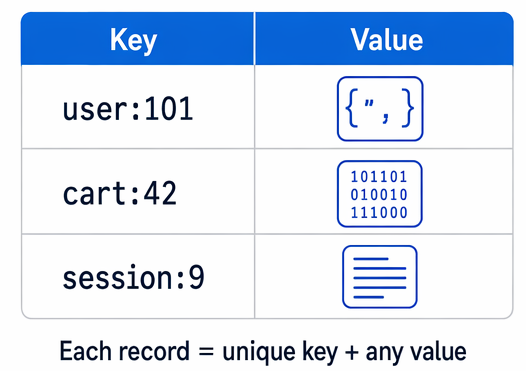
Each record is a unique key with an associated value in any format

Simple lookups by key

Document database

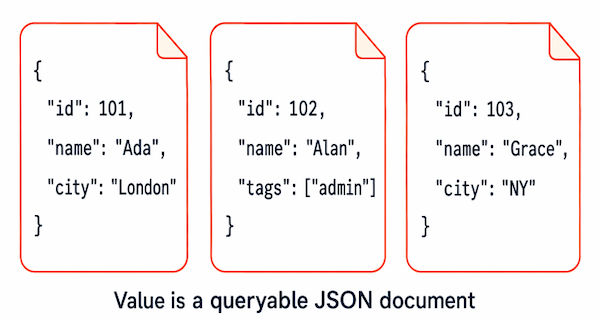
A specialized key-value store where the value is a JSON document optimized for parsing and querying

Flexible semi-structured objects

Column family database

Tabular rows and columns with columns divided into related families

Sparse data grouped by related columns

Graph database

Entities as nodes with links defining relationships

Complex relationships and traversals

Key-value database pairing unique keys with values

In a key-value store each record is a unique key plus a value in any format. A document database specializes this idea where the value is a JSON document that the engine can parse and query.

Document database storing JSON documents by key

A column family store keeps tabular rows but groups columns into families for logically related data. One illustration uses Row Key values row: 101 and row: 102, with a Profile family holding name and email such as name=Ada and email=ada@x, and an Activity family holding lastLogin and score such as lastLogin=2026-05-19 with score=42 and 2026-05-18 with 37. Row keys identify rows while families keep related columns together.

Diagram: Row Key, row: 101, row: 102, Profile family, name=Ada, email=ada@x, name=Alan, email=alan@x, Activity family, lastLogin=2026-05-19, score=42, lastLogin=2026-05-18, score=37

A graph database stores entities as nodes and relationships as edges. One example has four nodes — Ada, Alan, Grace, and Project X — and three edge types: Ada FOLLOWS Alan, Grace MANAGES Ada, plus both Grace and Alan WORKS_ON Project X. The edges make traversals such as who manages whom or who works on what project fast.

Diagram: Ada, Alan, Grace, Project X

7. A campus app team must store four kinds of data. Match each need to the right nonrelational database type.
  • Session token mapped to a blob
  • Student profiles as JSON queried by field
  • User IDs with Profile and Activity column groups
  • Friends as nodes with FOLLOWS edges
  • column family database
  • document database
  • graph database
  • key-value database
Show answer and explanation
  • Session token mapped to a blob: key-value database
  • Student profiles as JSON queried by field: document database
  • User IDs with Profile and Activity column groups: column family database
  • Friends as nodes with FOLLOWS edges: graph database

Key-value pairs a unique key with an opaque value.

Document values are JSON optimized for queries.

Column families group related columns together.

Graphs use nodes and edges for relationships.

8. A bookstore database stores customer details once and has each sales order reference the customer key. How does this relational design achieve normalization?
  • Storing customer details inside every order for speed
  • Requiring all data to be stored as JSON documents
  • Using primary keys to reference entities and eliminate duplication
  • Grouping columns into Profile and Activity families
Show answer and explanation
  • Using primary keys to reference entities and eliminate duplication

Primary keys uniquely identify instances and are referenced by other tables, so customer details are stored once instead of on every order.

9. In a graph database, entities are stored as ____ and the connections between them are stored as edges representing ____.
  • keys
  • nodes
  • relationships
  • tables
Show answer
  • In a graph database, entities are stored as nodes and the connections between them are stored as edges representing relationships.

Watch the video

Transactional workloads: OLTP

A transactional system records discrete events an organization tracks, such as money moving between bank accounts or retail payments for goods. Each transaction is a small, discrete unit of work. High-volume systems may handle many millions per day with fast access, a pattern called Online Transactional Processing (OLTP).

Diagram: Users / apps, Transfer $50, Buy item #502, Update address, Transactional database, Transactional store, Create, Read, Update, Delete, Fast, ACID, low latency, OLTP system

OLTP databases optimize storage for both reads and writes to support CRUD operations — create, retrieve, update, and delete — applied transactionally to preserve integrity. Consider a $40 transfer where Account A starts at $100 and Account B at $50: after the transfer A holds $60 and B holds $90, with a single arrow labeled Transfer $40 showing the movement between initial boxes on the left and final boxes on the right.

Diagram: Before transfer, Account A: $100, Account B: $50, After transfer, Account A: $60, Account B: $90

Reliability comes from ACID semantics, where each letter names a guarantee that the bank example makes concrete.

  • Atomicity treats each transaction as a single all-or-nothing unit. A debit from Account A plus a credit to Account B must both succeed or both fail; one illustration shows a successful transaction with a green checkmark and a failed one with a red cross to stress all or nothing.

  • Consistency allows transactions to move the database only from one valid state to another, so the completed state correctly reflects funds leaving one account and arriving in the other.

  • Isolation prevents concurrent transactions from interfering, giving each a consistent snapshot. While a transfer is in progress, a balance check must see either A=$100 with B=$50 or A=$60 with B=$90, never a mix such as the old value for one account and the new value for the other.

  • Durability means a committed transaction stays committed. After balances reach A=$60 and B=$90, the plug-into-socket commit with a lightning bolt persists them even after a crash or power-off, with before and after states shown as independent but equal.

Diagram: 1 transaction - success, Debit A, Credit B, ✓ Success, 1 transaction - failure, ✕ Failed, All or nothing

Diagram: Concurrent transactions, Transfer in progress, Balance check, Consistent snapshot only, A=$100, B=$50, A=$60, B=$90, Never a mix

Diagram: Before commit: A=$60, B=$90, Commit action, After commit: A=$60, B=$90

OLTP typically supports live line of business (LOB) applications that process day-to-day business data.

10. A bank tests its transfer system against ACID guarantees. Match each observed behavior to its guarantee.
  • Debit and credit both succeed or both fail
  • Database moves only from one valid balance state to another
  • Balance check never sees a mix of old and new values
  • Balances survive a crash after commit
  • Atomicity
  • Consistency
  • Durability
  • Isolation
Show answer and explanation
  • Debit and credit both succeed or both fail: Atomicity
  • Database moves only from one valid balance state to another: Consistency
  • Balance check never sees a mix of old and new values: Isolation
  • Balances survive a crash after commit: Durability

Atomicity is all-or-nothing completion.

Consistency preserves valid states.

Isolation prevents interference between concurrent work.

Durability persists committed work.

11. While a $40 transfer from Account A ($100) to Account B ($50) is in progress, another transaction checks both balances. What does isolation require of that balance check?
  • It should return A=$100 with B=$90 to show progress
  • It must return either both old values or both new values, never a mix
  • It must block all transfers until reporting finishes
  • It can return any combination since balances are independent
Show answer and explanation
  • It must return either both old values or both new values, never a mix

Isolation requires a consistent snapshot, so the check must return either both old balances or both new balances.

12. OLTP systems are optimized only for reading vast historical datasets and never handle writes.
  • True
  • False
Show answer and explanation
  • False

OLTP optimizes for both fast reads and writes to support CRUD transactions, not read-only historical analysis.

Watch the video

Analytical workloads

Analytical processing uses read-only or read-mostly systems holding vast volumes of history or business metrics. Analysis runs over a snapshot at a point in time or a series of snapshots, rather than over live transactional rows.

Diagram: 1 Operational data sources, Operational database, Business app UI, IoT sensors, 2 Central storage, Data Lakehouse, Data Warehouse, 3 Semantic model (OLAP), OLAP cube: date, customer, product, 4 Consumption, Bar chart reports, KPI 1.2M

Operational data is extracted, transformed, and loaded (ETL) into a lake for analysis, or extracted and loaded first with transformations afterward (ELT), common in modern lakehouses. Data lands in tabular schemas — in a lakehouse as tables over lake files or in a warehouse with a full relational SQL engine — then may be aggregated into an online analytical processing (OLAP) model, now often called a semantic model and historically a cube. Fact tables supply numeric measures aggregated by dimension tables; for example sales revenue can be totaled by date, customer, and product. Power BI semantic models are a common example. Lakes, warehouses, and models are then queried for reports, visualizations, and dashboards.

  • Data lakes collect large volumes of file-based data for large-scale analysis, often explored directly.

  • Data warehouses store data in a relational schema optimized for reads such as reporting queries.

  • Data lakehouses combine lake scale and flexibility with warehouse querying semantics; schemas may denormalize OLTP sources with some duplication for faster queries.

  • OLAP or semantic models preaggregate measures across dimensions at levels that support drill up and down, for example total sales by region, then city, then address, so summaries return quickly.

  • Data scientists work directly with files in a data lake to explore and model data

  • Data analysts query warehouse tables to build complex reports and visualizations

  • Business users consume preaggregated models as reports or dashboards

13. A retail chain builds an enterprise analytics pipeline. In what order does data flow through the architecture?
  • Data lands in central lakehouse or warehouse storage
  • Measures are aggregated in a semantic model by dimensions
  • Operational data sources generate transactions
  • Users consume reports, visualizations, and dashboards
Show answer
  1. Operational data sources generate transactions
  2. Data lands in central lakehouse or warehouse storage
  3. Measures are aggregated in a semantic model by dimensions
  4. Users consume reports, visualizations, and dashboards
14. An engineering team debates ETL versus ELT for feeding a lakehouse. How do the two patterns differ?
  • ETL loads raw files for analysts and ELT deletes history
  • ETL transforms data before loading and ELT loads first then transforms
  • ETL is only for OLTP and ELT is only for graphs
  • Both terms mean querying live transactions directly
Show answer and explanation
  • ETL transforms data before loading and ELT loads first then transforms

ETL transforms before loading while ELT loads first and transforms afterward, which suits flexible lakehouses.

15. Because analytical models preaggregate numeric measures by dimensions, summary queries over history can return quickly.
  • True
  • False
Show answer and explanation
  • True

Preaggregation across dimensions lets OLAP and semantic models answer summary queries quickly and drill between levels like region, city, and address.

Modern analytics platforms and organization

Azure covers the full pipeline from ingestion to reports. Two all-in-one workspaces bring most capabilities together, while a third handles governance. Microsoft Fabric is a unified software as a service analytics platform combining storage, data engineering, warehousing, and reporting in one workspace with OneLake, Lakehouse, Warehouse, Data Factory, and Power BI. Azure Databricks is a cloud platform for large-scale engineering and data science for Data engineering and Data science, using Delta Lake — Parquet plus a transaction log with ACID and versioning — as standard storage. Microsoft Purview provides unified security, governance, and compliance to discover, classify, protect, and manage data across sources.

Diagram: Microsoft Fabric, OneLake, Lakehouse, Warehouse, Data Factory, Power BI, OneLake (shared data lake), Azure Databricks, Data engineering, Data science, Delta Lake = Parquet + log (ACID, Versioning), Microsoft Purview, Discover, Classify, Protect, Manage

  • Use Fabric when a single SaaS workspace for storage, engineering, warehousing, and Power BI reporting is desired

  • Use Azure Databricks for large-scale engineering and science on Delta Lake format

  • Use Purview to discover, classify, protect, and manage data wherever it lives

Organizing with the medallion architecture

Lakehouses often use the medallion architecture with three quality layers. Bronze holds raw ingested data as-is such as CSV and log files with no transformations, preserving originals for reprocessing. Silver holds cleansed and conformed data with duplicates removed and types standardized, shown as a table with a checkmark. Gold holds aggregated, business-ready data for specific reporting uses, shown with a bar chart, pie chart, and KPI of 128 with a 12% increase. The pattern creates clear quality boundaries and lets teams reprocess from Bronze if requirements change. Both Fabric and Databricks add Copilot experiences for natural-language data exploration.

Diagram: Bronze Raw, CSV file, Log file, Silver Cleansed, Cleansed table, Gold Curated, Bar chart, Pie chart, KPI 128 +12%

16. A university lakehouse adopts the medallion pattern for enrollment data. What is the correct refinement sequence?
  • Bronze ingests raw CSV and log files as-is
  • Gold aggregates business-ready metrics for reports
  • Silver cleanses data and standardizes types
Show answer
  1. Bronze ingests raw CSV and log files as-is
  2. Silver cleanses data and standardizes types
  3. Gold aggregates business-ready metrics for reports
17. A college must choose between Microsoft Fabric and Microsoft Purview for two goals: analyzing enrollment in one workspace and governing data across all systems. How do the services differ?
  • Both provide identical SaaS reporting workspaces
  • Fabric provides unified analytics workspace and Purview provides governance across sources
  • Fabric only governs data and Purview only runs notebooks
  • Purview replaces Delta Lake as the storage format
Show answer and explanation
  • Fabric provides unified analytics workspace and Purview provides governance across sources

Fabric unifies storage, engineering, warehousing, and reporting while Purview focuses on discovering, classifying, protecting, and managing data.

18. Which Azure Databricks standard storage format combines Parquet with a transaction log to enable versioning and ACID transactions?
Show answer and explanation
  • Delta Lake, delta lake, Delta lake

Azure Databricks uses Delta Lake, Parquet plus a transaction log, as its standard format for versioning and ACID support.

Watch the video

Data powers digital transformation across organizations and society. At its simplest, data is a collection of facts — numbers, descriptions, and observations — used to record information, and data solutions provide the software and platforms to collect, store, and analyze it.

Over recent decades the volume created by systems, applications, and devices has grown sharply. Collection is easier and storage is cheaper, so almost every business can use data as a valuable asset to grow revenue, increase profit, and inform critical decisions. Capturing, storing, and analyzing data is now a core requirement, built on choices about representation, storage, and workload type.

Different people prefer different formats. Video presentations give an overview while written text provides greater detail, so text can be used as supplemental material to video.

Watch the video

Three formats of data

Data is often organized around entities important to a business, such as customers, products, and sales orders. Each entity has attributes or characteristics, for example a customer name, address, and phone number. The organization of those attributes falls into structured, semi-structured, and unstructured data.

Structured data follows a fixed schema where every instance has the same fields. It is usually tabular: each row represents one instance of an entity and each column represents an attribute. Customer and Product tables are typical examples, with columns such as customer ID, name, and city.

Structured customer and product data shown as tables with rows and columns

Tables for structured data are often linked through key values in a relational model, where multiple tables reference one another.

Semi-structured data has some structure but allows variation between instances. Most customers may have an email address, yet some have several addresses and some have none. JavaScript Object Notation (JSON) is a common representation, using hierarchical objects with differing fields per document.

// Customer 1
{
  "firstName": "Joe",
  "lastName": "Jones",
  "address":
  {
    "streetAddress": "1 Main St.",
    "city": "New York",
    "state": "NY",
    "postalCode": "10099"
  },
  "contact":
  [
    {
      "type": "home",
      "number": "555 123-1234"
    },
    {
      "type": "email",
      "address": "joe@litware.com"
    }
  ]
}

// Customer 2
{
  "firstName": "Samir",
  "lastName": "Nadoy",
  "address":
  {
    "streetAddress": "123 Elm Pl.",
    "unit": "500",
    "city": "Seattle",
    "state": "WA",
    "postalCode": "98999"
  },
  "contact":
  [
    {
      "type": "email",
      "address": "samir@northwind.com"
    }
  ]
}
Note

JSON is only one of many ways to express semi-structured data. The lesson is its flexibility, not JSON syntax itself.

Unstructured data has no preset tabular or hierarchical structure, including documents, images, audio, video, and binary files. Organizations increasingly convert this content into vector data, also called embeddings: numeric series produced by an embedding model. For example, a Word document, PDF file, image, sound wave, and video file on the left are passed through a blue arrow representing the embedding model to produce series of numbers on the right. A graph of semantic similarity against data points shows that vectors preserve meaning, which lets AI assistants answer questions over an organization's own documents and data.

Diagram: Unstructured data, Word document, PDF file, Image photo, Audio waveform, Video file, Vector data (embeddings), Vectors: 0.12, -0.34, 0.87, Similar meanings stay close, Embedding model

1. A university registrar stores every student with the same columns for ID, name, and enrollment year in a table. Why is this structured data rather than semi-structured data?
  • It allows each record to have different fields
  • It uses a fixed schema with the same fields for every record
  • It stores only images and video
  • It stores only numeric vectors
Show answer and explanation
  • It uses a fixed schema with the same fields for every record

Structured data uses a fixed tabular schema with the same columns for every row, while semi-structured data allows fields to vary between instances.

2. Vector data enables AI assistants to answer questions over an organization's own documents by representing unstructured content as numbers that preserve meaning.
  • True
  • False
Show answer and explanation
  • True

Embeddings are numeric vector representations that capture semantic similarity so AI assistants can search and answer over documents, images, and audio.

3. Match each university data example to its data format.
  • All products share identical ID, name, and price columns
  • One customer has two contacts, another has one, another has none
  • A collection of photos, PDFs, and video clips with no common fields
  • semi-structured data
  • structured data
  • unstructured data
Show answer and explanation
  • All products share identical ID, name, and price columns: structured data
  • One customer has two contacts, another has one, another has none: semi-structured data
  • A collection of photos, PDFs, and video clips with no common fields: unstructured data

Fixed-schema rows and columns define structured data.

Varying fields per instance define semi-structured data.

Lack of preset structure defines unstructured data.

Where data lives: files and databases

Stored data records entities such as customers and products, events such as sales transactions, and content such as documents and images for later retrieval and analysis. Two broad categories of store are in common use: file stores and databases, explored in the following sections.

Watch the video

File storage in practice

Files remain fundamental to computing, from local hard disks and USB drives to central shared storage. Central storage is increasingly hosted in the cloud for cost-effective, secure, and reliable handling of large volumes.

  • The type of data being stored — structured, semi-structured, or unstructured

  • The applications and services that must read, write, and process the data

  • Whether files must be human-readable or optimized for efficient storage and processing

Delimited text files

Delimited text stores structured data in plain, human-readable form with field delimiters and row terminators. Comma-separated values (CSV) separates fields with commas and ends rows with carriage return and line feed, optionally with field names in the first line. Variants include tab-separated values, space-delimited, and fixed-width formats that allocate a fixed character count per field.

FirstName,LastName,Email
Joe,Jones,joe@litware.com
Samir,Nadoy,samir@northwind.com

JSON files

JSON defines hierarchical objects with multiple attributes, where each attribute can itself be an object or collection. Objects use braces, collections use square brackets, and attributes use name:value pairs separated by commas. The format suits both structured and semi-structured data, as shown by a customers collection where each customer has firstName, lastName, and a contact collection with varying email and phone entries.

{
  "customers":
  [
    {
      "firstName": "Joe",
      "lastName": "Jones",
      "contact":
      [
        {
          "type": "home",
          "number": "555 123-1234"
        },
        {
          "type": "email",
          "address": "joe@litware.com"
        }
      ]
    },
    {
      "firstName": "Samir",
      "lastName": "Nadoy",
      "contact":
      [
        {
          "type": "email",
          "address": "samir@northwind.com"
        }
      ]
    }
  ]
}

XML

Extensible Markup Language (XML) is a human-readable format popular in the 1990s and 2000s that uses tags in angle brackets to define elements and attributes. It has largely been replaced by less verbose JSON but persists in some systems.

<Customers>
  <Customer name="Joe" lastName="Jones">
    <ContactDetails>
      <Contact type="home" number="555 123-1234"/>
      <Contact type="email" address="joe@litware.com"/>
    </ContactDetails>
  </Customer>
  <Customer name="Samir" lastName="Nadoy">
    <ContactDetails>
      <Contact type="email" address="samir@northwind.com"/>
    </ContactDetails>
  </Customer>
</Customers>

Binary files and BLOBs

All files are ultimately binary ones and zeros, but readable formats map those bytes to printable characters through encodings such as ASCII or Unicode. Images, video, audio, and application-specific documents instead keep raw binary that applications must interpret and render. Data professionals call such files BLOBs (Binary Large Objects).

Optimized formats for analytics

Human-readable formats aid compatibility but waste space and processing time. Specialized formats add compression, indexing, and efficient encoding. Parquet is an Apache columnar format and the de facto standard for modern lakehouses, labeled as great for analytics and compression. A Parquet file holds row groups; data for each column such as ID, Name, City, and Age is stored together in the same group, with three person rows in the main section and a smaller row-group view showing one row. Metadata describes schema and per-chunk row sets and statistics, letting an application locate the correct chunk and fetch only needed columns. Parquet handles nested types efficiently.

Diagram: Row group, ID: 1, 2, 3, Name: Alice, Bob, Carol, City: New York, London, Paris, Age: 25, 30, 35, Table: ID, Name, City, Age (3 rows), Metadata: schema + stats

Avro is an Apache row-based format, great for streaming and data exchange. Each file starts with a header in JSON that describes the structure, followed by binary blocks of records. Applications use the header to parse fields, which compresses data and reduces storage and network bandwidth. Its layout can be compared to a JSON schema of type record named Person with four fields — ID, Name, City, Age, each with name and type — beside an Avro table holding three records with those same columns.

Diagram: Avro row-based, ID | Name | City | Age, 1 | Alice | New York | 25, 2 | Bob | London | 30, 3 | Carol | Paris | 35, Header (JSON schema), Person schema: ID int, Name string, City string, Age int, Great for streaming and data exchange

Delta Lake is an open-source storage format that builds on Parquet by adding a transaction log named _delta_log. Three independent Parquet files named part-00.parquet, part-01.parquet, and part-02.parquet have no direct links to each other; each connects to the central log, where versions v0, v1, and v2 each map to a corresponding file. The log enables ACID transactions, versioning, and time travel for querying past states and reliable updates on a data lake.

Diagram: Parquet files, part-00.parquet, part-01.parquet, part-02.parquet, _delta_log, v0, v1, v2, ACID · versioning · time travel

4. A university IT team must choose file formats for four needs. Match each need to the best format.
  • Enrollment list shared with many tools in readable text
  • Student profiles with varying contact methods in nested objects
  • Billion-row grades table queried by column for averages
  • Lecture recordings and scanned diagrams
  • BLOB
  • delimited text (CSV)
  • JSON
  • Parquet
Show answer and explanation
  • Enrollment list shared with many tools in readable text: delimited text (CSV)
  • Student profiles with varying contact methods in nested objects: JSON
  • Billion-row grades table queried by column for averages: Parquet
  • Lecture recordings and scanned diagrams: BLOB

CSV is plain delimited text readable by many tools.

JSON supports hierarchical flexible objects.

Parquet columnar layout speeds analytics and compression.

BLOB holds raw binary needing application rendering.

5. A research lab must pick between Parquet and Avro for two pipelines: fast aggregation over large datasets and continuous streaming exchange. How do the formats differ?
  • Avro is columnar for analytics and Parquet is row-based for streaming
  • Parquet is columnar for analytics and Avro is row-based for streaming
  • Both are identical human-readable text formats
  • Both require a Delta Lake transaction log to function
Show answer and explanation
  • Parquet is columnar for analytics and Avro is row-based for streaming

Avro stores rows with a JSON header and binary blocks, favoring streaming and exchange, while Parquet stores columns together in row groups with metadata, favoring analytics and compression.

6. Delta Lake enables ACID transactions and versioned time travel by adding a transaction log on top of Parquet files.
  • True
  • False
Show answer and explanation
  • True

Delta Lake layers a transaction log over Parquet files to provide ACID transactions, versioning, and time travel on lake storage.

Watch the video

Databases for organized management

A database is a central system for storing and querying data records, more managed than simply keeping files in a file system. The two major families are relational and nonrelational systems.

Relational databases

Relational databases store structured data in tables for entities such as customers, products, or sales orders. Each instance gets a primary key that uniquely identifies it, and other tables reference that key — for example a sales order references a customer key to show who placed it. Keys support normalization, which removes duplicate values by storing customer details once rather than repeating them on every order. Tables are managed with Structured Query Language (SQL), based on an ANSI standard so dialects stay similar across systems.

A typical schema therefore shows Customer, Product, and Sales Order tables linked by key relationships, illustrating how duplication is avoided while preserving connections between entities.

Nonrelational databases

Nonrelational databases, often called NoSQL, do not enforce a relational schema, though some support a variant of SQL. Four common types cover different access patterns.

Type

How it stores data

Strength

Key-value database

Each record is a unique key with an associated value in any format

Simple lookups by key

Document database

A specialized key-value store where the value is a JSON document optimized for parsing and querying

Flexible semi-structured objects

Column family database

Tabular rows and columns with columns divided into related families

Sparse data grouped by related columns

Graph database

Entities as nodes with links defining relationships

Complex relationships and traversals

Key-value database pairing unique keys with values

In a key-value store each record is a unique key plus a value in any format. A document database specializes this idea where the value is a JSON document that the engine can parse and query.

Document database storing JSON documents by key

A column family store keeps tabular rows but groups columns into families for logically related data. One illustration uses Row Key values row: 101 and row: 102, with a Profile family holding name and email such as name=Ada and email=ada@x, and an Activity family holding lastLogin and score such as lastLogin=2026-05-19 with score=42 and 2026-05-18 with 37. Row keys identify rows while families keep related columns together.

Diagram: Row Key, row: 101, row: 102, Profile family, name=Ada, email=ada@x, name=Alan, email=alan@x, Activity family, lastLogin=2026-05-19, score=42, lastLogin=2026-05-18, score=37

A graph database stores entities as nodes and relationships as edges. One example has four nodes — Ada, Alan, Grace, and Project X — and three edge types: Ada FOLLOWS Alan, Grace MANAGES Ada, plus both Grace and Alan WORKS_ON Project X. The edges make traversals such as who manages whom or who works on what project fast.

Diagram: Ada, Alan, Grace, Project X

7. A campus app team must store four kinds of data. Match each need to the right nonrelational database type.
  • Session token mapped to a blob
  • Student profiles as JSON queried by field
  • User IDs with Profile and Activity column groups
  • Friends as nodes with FOLLOWS edges
  • column family database
  • document database
  • graph database
  • key-value database
Show answer and explanation
  • Session token mapped to a blob: key-value database
  • Student profiles as JSON queried by field: document database
  • User IDs with Profile and Activity column groups: column family database
  • Friends as nodes with FOLLOWS edges: graph database

Key-value pairs a unique key with an opaque value.

Document values are JSON optimized for queries.

Column families group related columns together.

Graphs use nodes and edges for relationships.

8. A bookstore database stores customer details once and has each sales order reference the customer key. How does this relational design achieve normalization?
  • Storing customer details inside every order for speed
  • Requiring all data to be stored as JSON documents
  • Using primary keys to reference entities and eliminate duplication
  • Grouping columns into Profile and Activity families
Show answer and explanation
  • Using primary keys to reference entities and eliminate duplication

Primary keys uniquely identify instances and are referenced by other tables, so customer details are stored once instead of on every order.

9. In a graph database, entities are stored as ____ and the connections between them are stored as edges representing ____.
  • keys
  • nodes
  • relationships
  • tables
Show answer
  • In a graph database, entities are stored as nodes and the connections between them are stored as edges representing relationships.

Watch the video

Transactional workloads: OLTP

A transactional system records discrete events an organization tracks, such as money moving between bank accounts or retail payments for goods. Each transaction is a small, discrete unit of work. High-volume systems may handle many millions per day with fast access, a pattern called Online Transactional Processing (OLTP).

Diagram: Users / apps, Transfer $50, Buy item #502, Update address, Transactional database, Transactional store, Create, Read, Update, Delete, Fast, ACID, low latency, OLTP system

OLTP databases optimize storage for both reads and writes to support CRUD operations — create, retrieve, update, and delete — applied transactionally to preserve integrity. Consider a $40 transfer where Account A starts at $100 and Account B at $50: after the transfer A holds $60 and B holds $90, with a single arrow labeled Transfer $40 showing the movement between initial boxes on the left and final boxes on the right.

Diagram: Before transfer, Account A: $100, Account B: $50, After transfer, Account A: $60, Account B: $90

Reliability comes from ACID semantics, where each letter names a guarantee that the bank example makes concrete.

  • Atomicity treats each transaction as a single all-or-nothing unit. A debit from Account A plus a credit to Account B must both succeed or both fail; one illustration shows a successful transaction with a green checkmark and a failed one with a red cross to stress all or nothing.

  • Consistency allows transactions to move the database only from one valid state to another, so the completed state correctly reflects funds leaving one account and arriving in the other.

  • Isolation prevents concurrent transactions from interfering, giving each a consistent snapshot. While a transfer is in progress, a balance check must see either A=$100 with B=$50 or A=$60 with B=$90, never a mix such as the old value for one account and the new value for the other.

  • Durability means a committed transaction stays committed. After balances reach A=$60 and B=$90, the plug-into-socket commit with a lightning bolt persists them even after a crash or power-off, with before and after states shown as independent but equal.

Diagram: 1 transaction - success, Debit A, Credit B, ✓ Success, 1 transaction - failure, ✕ Failed, All or nothing

Diagram: Concurrent transactions, Transfer in progress, Balance check, Consistent snapshot only, A=$100, B=$50, A=$60, B=$90, Never a mix

Diagram: Before commit: A=$60, B=$90, Commit action, After commit: A=$60, B=$90

OLTP typically supports live line of business (LOB) applications that process day-to-day business data.

10. A bank tests its transfer system against ACID guarantees. Match each observed behavior to its guarantee.
  • Debit and credit both succeed or both fail
  • Database moves only from one valid balance state to another
  • Balance check never sees a mix of old and new values
  • Balances survive a crash after commit
  • Atomicity
  • Consistency
  • Durability
  • Isolation
Show answer and explanation
  • Debit and credit both succeed or both fail: Atomicity
  • Database moves only from one valid balance state to another: Consistency
  • Balance check never sees a mix of old and new values: Isolation
  • Balances survive a crash after commit: Durability

Atomicity is all-or-nothing completion.

Consistency preserves valid states.

Isolation prevents interference between concurrent work.

Durability persists committed work.

11. While a $40 transfer from Account A ($100) to Account B ($50) is in progress, another transaction checks both balances. What does isolation require of that balance check?
  • It should return A=$100 with B=$90 to show progress
  • It must return either both old values or both new values, never a mix
  • It must block all transfers until reporting finishes
  • It can return any combination since balances are independent
Show answer and explanation
  • It must return either both old values or both new values, never a mix

Isolation requires a consistent snapshot, so the check must return either both old balances or both new balances.

12. OLTP systems are optimized only for reading vast historical datasets and never handle writes.
  • True
  • False
Show answer and explanation
  • False

OLTP optimizes for both fast reads and writes to support CRUD transactions, not read-only historical analysis.

Watch the video

Analytical workloads

Analytical processing uses read-only or read-mostly systems holding vast volumes of history or business metrics. Analysis runs over a snapshot at a point in time or a series of snapshots, rather than over live transactional rows.

Diagram: 1 Operational data sources, Operational database, Business app UI, IoT sensors, 2 Central storage, Data Lakehouse, Data Warehouse, 3 Semantic model (OLAP), OLAP cube: date, customer, product, 4 Consumption, Bar chart reports, KPI 1.2M

Operational data is extracted, transformed, and loaded (ETL) into a lake for analysis, or extracted and loaded first with transformations afterward (ELT), common in modern lakehouses. Data lands in tabular schemas — in a lakehouse as tables over lake files or in a warehouse with a full relational SQL engine — then may be aggregated into an online analytical processing (OLAP) model, now often called a semantic model and historically a cube. Fact tables supply numeric measures aggregated by dimension tables; for example sales revenue can be totaled by date, customer, and product. Power BI semantic models are a common example. Lakes, warehouses, and models are then queried for reports, visualizations, and dashboards.

  • Data lakes collect large volumes of file-based data for large-scale analysis, often explored directly.

  • Data warehouses store data in a relational schema optimized for reads such as reporting queries.

  • Data lakehouses combine lake scale and flexibility with warehouse querying semantics; schemas may denormalize OLTP sources with some duplication for faster queries.

  • OLAP or semantic models preaggregate measures across dimensions at levels that support drill up and down, for example total sales by region, then city, then address, so summaries return quickly.

  • Data scientists work directly with files in a data lake to explore and model data

  • Data analysts query warehouse tables to build complex reports and visualizations

  • Business users consume preaggregated models as reports or dashboards

13. A retail chain builds an enterprise analytics pipeline. In what order does data flow through the architecture?
  • Data lands in central lakehouse or warehouse storage
  • Measures are aggregated in a semantic model by dimensions
  • Operational data sources generate transactions
  • Users consume reports, visualizations, and dashboards
Show answer
  1. Operational data sources generate transactions
  2. Data lands in central lakehouse or warehouse storage
  3. Measures are aggregated in a semantic model by dimensions
  4. Users consume reports, visualizations, and dashboards
14. An engineering team debates ETL versus ELT for feeding a lakehouse. How do the two patterns differ?
  • ETL loads raw files for analysts and ELT deletes history
  • ETL transforms data before loading and ELT loads first then transforms
  • ETL is only for OLTP and ELT is only for graphs
  • Both terms mean querying live transactions directly
Show answer and explanation
  • ETL transforms data before loading and ELT loads first then transforms

ETL transforms before loading while ELT loads first and transforms afterward, which suits flexible lakehouses.

15. Because analytical models preaggregate numeric measures by dimensions, summary queries over history can return quickly.
  • True
  • False
Show answer and explanation
  • True

Preaggregation across dimensions lets OLAP and semantic models answer summary queries quickly and drill between levels like region, city, and address.

Modern analytics platforms and organization

Azure covers the full pipeline from ingestion to reports. Two all-in-one workspaces bring most capabilities together, while a third handles governance. Microsoft Fabric is a unified software as a service analytics platform combining storage, data engineering, warehousing, and reporting in one workspace with OneLake, Lakehouse, Warehouse, Data Factory, and Power BI. Azure Databricks is a cloud platform for large-scale engineering and data science for Data engineering and Data science, using Delta Lake — Parquet plus a transaction log with ACID and versioning — as standard storage. Microsoft Purview provides unified security, governance, and compliance to discover, classify, protect, and manage data across sources.

Diagram: Microsoft Fabric, OneLake, Lakehouse, Warehouse, Data Factory, Power BI, OneLake (shared data lake), Azure Databricks, Data engineering, Data science, Delta Lake = Parquet + log (ACID, Versioning), Microsoft Purview, Discover, Classify, Protect, Manage

  • Use Fabric when a single SaaS workspace for storage, engineering, warehousing, and Power BI reporting is desired

  • Use Azure Databricks for large-scale engineering and science on Delta Lake format

  • Use Purview to discover, classify, protect, and manage data wherever it lives

Organizing with the medallion architecture

Lakehouses often use the medallion architecture with three quality layers. Bronze holds raw ingested data as-is such as CSV and log files with no transformations, preserving originals for reprocessing. Silver holds cleansed and conformed data with duplicates removed and types standardized, shown as a table with a checkmark. Gold holds aggregated, business-ready data for specific reporting uses, shown with a bar chart, pie chart, and KPI of 128 with a 12% increase. The pattern creates clear quality boundaries and lets teams reprocess from Bronze if requirements change. Both Fabric and Databricks add Copilot experiences for natural-language data exploration.

Diagram: Bronze Raw, CSV file, Log file, Silver Cleansed, Cleansed table, Gold Curated, Bar chart, Pie chart, KPI 128 +12%

16. A university lakehouse adopts the medallion pattern for enrollment data. What is the correct refinement sequence?
  • Bronze ingests raw CSV and log files as-is
  • Gold aggregates business-ready metrics for reports
  • Silver cleanses data and standardizes types
Show answer
  1. Bronze ingests raw CSV and log files as-is
  2. Silver cleanses data and standardizes types
  3. Gold aggregates business-ready metrics for reports
17. A college must choose between Microsoft Fabric and Microsoft Purview for two goals: analyzing enrollment in one workspace and governing data across all systems. How do the services differ?
  • Both provide identical SaaS reporting workspaces
  • Fabric provides unified analytics workspace and Purview provides governance across sources
  • Fabric only governs data and Purview only runs notebooks
  • Purview replaces Delta Lake as the storage format
Show answer and explanation
  • Fabric provides unified analytics workspace and Purview provides governance across sources

Fabric unifies storage, engineering, warehousing, and reporting while Purview focuses on discovering, classifying, protecting, and managing data.

18. Which Azure Databricks standard storage format combines Parquet with a transaction log to enable versioning and ACID transactions?
Show answer and explanation
  • Delta Lake, delta lake, Delta lake

Azure Databricks uses Delta Lake, Parquet plus a transaction log, as its standard format for versioning and ACID support.

Watch the video

Extra questions

19. Link each business inquiry to the analytics category that answers it.
  • Reason sales climbed in the prior month
  • Concrete advice for splitting the present budget across stock buys
  • Spotting firm logo pictures buried in PDF files
  • Cognitive
  • Diagnostic
  • Prescriptive
Show answer and explanation
  • Reason sales climbed in the prior month: Diagnostic
  • Concrete advice for splitting the present budget across stock buys: Prescriptive
  • Spotting firm logo pictures buried in PDF files: Cognitive

Asking the reason behind a past rise seeks its cause.

Telling how to spend the present budget advises concrete steps.

Spotting logos inside PDFs needs vision AI for images, which is cognitive.

20. Complete the sentence: Converting spoken audio files into text is an illustration of ____ analytics.
  • cognitive
  • descriptive
  • predictive
  • prescriptive
Show answer
  • Complete the sentence: Converting spoken audio files into text is an illustration of cognitive analytics.
21. Complete the sentence: A JSON document where each entity may carry different fields shows ____.
  • relational data
  • semi-structured data
  • structured data
  • unstructured data
Show answer
  • Complete the sentence: A JSON document where each entity may carry different fields shows semi-structured data.
22. Complete the sentence: A graphic contrasting present university enrollment with total capacity illustrates ____ analytics.
  • cognitive
  • descriptive
  • predictive
  • prescriptive
Show answer
  • Complete the sentence: A graphic contrasting present university enrollment with total capacity illustrates descriptive analytics.
23. Which trait describes non-relational data?
  • Has no indexes
  • Has self-describing entities
  • Has a well-defined schema
  • Has no unique key values
Show answer and explanation
  • Has self-describing entities

Non-relational data is often kept as self-describing entities such as JSON documents that carry their own field names rather than obeying a fixed table schema. A well-defined enforced schema belongs to relational data. Non-relational stores still commonly use unique keys and indexes.

24. A database will hold website session information including notifications, personalization attributes, and shopping-cart products. Which store type gives the fastest retrieval?
  • key/value
  • graph
  • columnar
  • document
Show answer and explanation
  • key/value

Website session content such as notifications, personalization attributes, and cart products is always fetched by session identifier. A key/value store returns the value for a known key with very low latency. Document stores add query overhead, while graph and columnar stores target relationship traversal and analytics rather than fast single-key lookups.

Review the JSON sample below and decide what kind of JSON element each named property represents.

"customer" : {
    "first name" : "Ben",
    "last name" : "Smith",
    "address" : {
        "line 1" : "161 Azure Ln",
        "line 2" : "Palo Alto",
        "ZIP code" : "54762"
    },
    "social media": [
        {
            "service" : "twitter",
            "handle" : "@bensmith"
        },
        {
            "service" : "linkedin",
            "handle" : "bensmith"
        }
    ],
    "phone numbers": [
        {
            "type" : "mobile",
            "number" : "555-555-555"
        }
    ]
}
25. From the document, Customer is ____, Address is ____, and Social media is ____.
Show answer
  • From the document, Customer is a root object, Address is a nested object, and Social media is a nested array.
26. Link each business inquiry to the analytics category that answers it.
  • Reason sales grew during the prior month
  • How to divide a budget across inventory purchases
  • Which individuals are named in company papers
  • Cognitive
  • Diagnostic
  • Prescriptive
Show answer and explanation
  • Reason sales grew during the prior month: Diagnostic
  • How to divide a budget across inventory purchases: Prescriptive
  • Which individuals are named in company papers: Cognitive

Explaining the cause of a past sales rise answers why something happened.

Suggesting how to divide funds among stock purchases recommends actions to reach a goal.

Spotting names in business papers needs AI interpretation of unstructured text.

27. Complete the sentence: Descriptive analytics reports ____.
  • what has already happened
  • what steps to take to influence results
  • what will probably happen in the future
  • why past events happened
Show answer
  • Complete the sentence: Descriptive analytics reports what has already happened.
28. Which transactional-workload promise treats each transaction as one indivisible unit that must either complete entirely or not happen at all?
  • atomicity
  • isolation
  • durability
  • consistency
Show answer and explanation
  • atomicity

Atomicity gives the all-or-nothing promise: every step inside the transaction finishes or the whole transaction is rolled back. Consistency moves data from one valid state to another, isolation prevents concurrent transactions from disturbing each other, and durability makes committed work survive later failures.

29. A company must design a database showing how traffic shifts in one part of a network influence traffic in other parts. Which kind of data store should be chosen?
  • graph
  • key/value
  • document
  • columnar
Show answer and explanation
  • graph

Effects spreading between areas are relationships between connected entities. A graph store represents areas or devices as nodes and links as edges and can traverse those connections efficiently. Key/value, document, and columnar stores keep records but do not model or traverse relationships natively.

You have stored information in the structure shown below.

{
    "firstname": "John",
    "lastName": "Doe",
    "age": "23",
    "hobbies": [
        { "type": "Sports", "value": "Golf" },
        { "type": "Leisure", "value": "Reading" },
        { "type": "Leisure", "value": "Guitar" }
    ]
}
30. Which format was used for this saved data?
  • XML
  • HTML
  • YAML
  • JSON
Show answer and explanation
  • JSON

Curly braces for objects, square brackets for arrays, and quoted name-value pairs separated by commas identify JavaScript Object Notation. XML and HTML use angle-bracket tags, and YAML relies on indentation and dashes.

You have stored information in the delimited layout shown below.

FirstName, LastName, Age, LeisureHobby, SportsHobby
John, Smith, 23, Reading, Basketball
Ben, Smith, 21, Guitar, Curling
31. Which format was used for this saved data?
  • YAML
  • CSV
  • JSON
  • HTML
Show answer and explanation
  • CSV

A header row followed by one record per line with comma-separated values identifies comma-separated values. JSON uses braces and pairs, HTML uses tags, and YAML uses indented key-value lines.

32. Social connections such as users and followers held in a graph database illustrate ____
  • semi-structured data.
  • structured data.
  • unstructured data.
Show answer
  • Social connections such as users and followers held in a graph database illustrate semi-structured data.

You hold two customer data sets organized in rows and columns and linked through a shared identifier.

CustomerIDNameStyleTitleFirstNameMiddleNameLastName
294860Ms.KimNULLAbercrombie
294890Ms.FrancesB.Adams
294900Ms.MargaretJ.Smith
294920Mr.JayNULLAdams
CustomerIDAddressIDAddressTypeModifiedDate
29486621Main Office9/1/05 0:00
294891069Main Office7/1/05 0:00
29490887Main Office9/1/06 0:00
29492618Main Office12/1/06 0:00
29494537Main Office9/1/05 0:00
33. What kind of data do these tables hold?
  • structured
  • non-relational
  • semi-structured
  • unstructured
Show answer and explanation
  • structured

Fixed-schema tables with named columns and rows linked by a shared CustomerID key are structured relational data. Semi-structured data such as JSON is flexible and self-describing, and unstructured data such as images has no tabular schema.

You have stored information in the structure shown below.

<Person Age="23">
    <FirstName>John</FirstName>
    <LastName>Smith</LastName>
    <Hobbies>
        <Hobby Type="Sports">Golf</Hobby>
        <Hobby Type="Leisure">Reading</Hobby>
        <Hobby Type="Leisure">Guitar</Hobby>
    </Hobbies>
</Person>
34. Which format was used for this saved data?
  • JSON
  • YAML
  • HTML
  • XML
Show answer and explanation
  • XML

Custom self-describing tags such as Person and Hobby with attributes such as Age and Type identify Extensible Markup Language. HTML uses only a predefined layout tag set, JSON uses braces and name-value pairs, and YAML uses indentation.

35. A non-relational store must be optimized for text files, videos, audio streams, and virtual disk images, keeping the data with some metadata and a unique identifier per file. Which store type should be recommended?
  • key/value
  • columnar
  • object
  • document
Show answer and explanation
  • object

An object store is built for large binary objects such as videos, audio streams, images, text files, and virtual disk images, keeping data plus metadata plus a unique identifier per object. Azure Blob Storage is the Azure object store. Document and key/value stores suit smaller records queried by field or key.

36. An application will write a large amount of JSON data using a schema defined by the application. Which store type should be chosen?
  • columnar
  • key/value
  • document
  • graph
Show answer and explanation
  • document

A document store keeps semi-structured JSON documents whose structure is defined by the application, with fields varying per document. A key/value store treats values as opaque, a columnar store groups data into column families, and a graph store models entities and relationships.

37. A store will collect readings from internet-connected temperature sensors for trend analysis. Which store type should be used?
  • relational
  • time series
  • graph
  • columnar
Show answer and explanation
  • time series

Sensor readings ordered by time are time series data. A time series store is tuned for high-volume appends of timestamped values and aggregations over time windows for trend analysis. Relational, graph, and columnar stores can hold the values but are not optimized for that pattern.

38. A transfer must debit one account and credit another together, so if either leg fails the other must also fail. Which ACID property does this show?
  • consistency
  • durability
  • atomicity
  • isolation
Show answer and explanation
  • atomicity

Atomicity treats the debit plus credit as one indivisible unit, so both persist or neither does. Consistency, isolation, and durability address validity, concurrency, and survival of committed work.

39. Sound recordings are kept with ____. JSON documents are kept with ____. Row-and-column datasets are kept with ____.
  • Azure Blob Storage
  • Azure Cosmos DB for NoSQL
  • Azure Data Factory
  • Azure SQL Database
Show answer
  • Sound recordings are kept with Azure Blob Storage. JSON documents are kept with Azure Cosmos DB for NoSQL. Row-and-column datasets are kept with Azure SQL Database.
40. OLTP depends on storage tuned for both read and write activity.
  • True
  • False
Show answer and explanation
  • True

OLTP handles many small reads and writes, so it is tuned for both operations.

41. OLAP depends on storage tuned for both read and write activity.
  • True
  • False
Show answer and explanation
  • False

OLAP is loaded periodically and then queried heavily, so it is tuned for reads rather than frequent writes.

42. Data warehouses are tuned for read operations.
  • True
  • False
Show answer and explanation
  • True

Warehouses use schemas designed for fast reads and aggregations.

43. The ____ layout keeps delimited records, dividing fields with commas and ending rows with a carriage return.
  • CSV
  • JSON
  • TSV
  • XML
Show answer
  • The CSV layout keeps delimited records, dividing fields with commas and ending rows with a carriage return.
44. A banking platform moves funds between accounts and must prevent any read from seeing the source balance as if the move had not happened while seeing the destination balance as if it had. Which ACID property does this illustrate?
  • atomicity
  • durability
  • consistency
  • isolation
Show answer and explanation
  • isolation

Isolation hides the intermediate state of concurrent transactions, so no reader observes one account already changed while the other is still unchanged. Atomicity provides all-or-nothing completion but does not control visibility during execution. Consistency preserves validity rules and durability preserves committed work through failures.

45. A shop checkout terminal operating as a point of sale (POS) system represents which solution category?
  • a data warehouse
  • online analytical processing (OLAP)
  • extract, transform, and load (ETL)
  • online transaction processing (OLTP)
Show answer and explanation
  • online transaction processing (OLTP)

A point-of-sale terminal records individual sales immediately with fast small writes, the hallmark of OLTP. Warehouses and OLAP serve analysis of historical data, while ETL is the movement process between systems.

46. How does structured data differ from semi-structured data?
  • Structured data follows a fixed schema while semi-structured data allows a flexible schema.
  • Only structured data can represent entities.
  • Structured data allows a flexible schema while semi-structured data requires a fixed schema.
  • Only structured data can represent attributes.
Show answer and explanation
  • Structured data follows a fixed schema while semi-structured data allows a flexible schema.

Structured data follows an identical fixed schema for every row, while semi-structured formats like JSON permit varying fields and a flexible schema. Both describe entities through attributes.

47. A banking app that pays money in and out of accounts exemplifies which solution type?
  • online transaction processing (OLTP)
  • online analytical processing (OLAP)
  • extract, transform and load (ETL)
  • a data warehouse
Show answer and explanation
  • online transaction processing (OLTP)

Account transfers update individual records instantly under ACID rules, the OLTP pattern. OLAP, warehouses, and ETL concern historical analysis and data movement, not live operations.

48. Information held in a data warehouse can be summarized and loaded into an OLAP model, which is alternatively termed a ____
  • cube.
  • data lake.
  • dimension.
  • measure.
Show answer
  • Information held in a data warehouse can be summarized and loaded into an OLAP model, which is alternatively termed a cube.
49. Which file type defines names and data types per column and keeps data in compressed columnar form?
  • HTML
  • CSV
  • Apache Parquet
  • JSON
Show answer and explanation
  • Apache Parquet

Parquet stores typed columns and compresses data column by column, making it efficient for analytics. CSV is row-based text without types, JSON is semi-structured text, and HTML is markup for web pages.

50. A bank must keep revised balances after a transfer even if the hosting system briefly fails. Which ACID property does this need show?
  • durability
  • isolation
  • atomicity
  • consistency
Show answer and explanation
  • durability

Durability makes committed updates survive later outages. Atomicity covers all-or-nothing execution, consistency covers valid state transitions, and isolation covers interference between concurrent transactions.

51. A JSON customer record whose fields vary from one entity to the next exemplifies ____ data.
  • relational
  • semi-structured
  • structured
  • unstructured
Show answer
  • A JSON customer record whose fields vary from one entity to the next exemplifies semi-structured data.
52. Which activity typifies transactional workloads?
  • capturing tiny real-time business events
  • summarizing huge volumes of history
  • building elaborate reports
  • carrying out self-service exploration
Show answer and explanation
  • capturing tiny real-time business events

OLTP captures many tiny real-time events such as orders or payments. Heavy aggregation, elaborate reporting, and self-service exploration over history characterize analytic workloads.

53. The ____ layout describes multi-attribute entities through a nested document schema.
  • CSV
  • JSON
  • ORC
  • TSV
Show answer
  • The JSON layout describes multi-attribute entities through a nested document schema.
54. Complete the sentence: An online analytical processing (OLAP) model holds ____ data shaped for analytical workloads.
  • aggregated
  • normalized
  • semi-structured
  • unstructured
Show answer
  • Complete the sentence: An online analytical processing (OLAP) model holds aggregated data shaped for analytical workloads.
55. Link each ACID property to its correct description.
  • Concurrent transactions cannot interfere with one another and must result in a consistent database state.
  • Each transaction is treated as a single unit that succeeds completely or fails completely.
  • Transactions can only take the data in a database from one valid state to another.
  • When a transaction is committed, it will remain committed.
  • Atomicity
  • Consistency
  • Durability
  • Isolation
Show answer and explanation
  • Concurrent transactions cannot interfere with one another and must result in a consistent database state.: Isolation
  • Each transaction is treated as a single unit that succeeds completely or fails completely.: Atomicity
  • Transactions can only take the data in a database from one valid state to another.: Consistency
  • When a transaction is committed, it will remain committed.: Durability

Isolation keeps concurrent transactions from affecting each other, even though the wording mentions a consistent state.

Atomicity requires the whole transaction to succeed or the whole transaction to fail.

Consistency ensures a transaction shifts the database between valid states only.

Durability guarantees that once committed, changes persist through failures.

56. Structured content in which every row stands for one entity follows which schema style?
  • XML
  • tabular
  • blob
  • JSON
Show answer and explanation
  • tabular

Structured content is tabular with a fixed schema of rows for entities and columns for attributes. XML and JSON are semi-structured, and blobs hold unstructured binary material.

You hold the following JSON records with nested address details, where one entry also carries contact information.

[
{
  "firstName": "John",
  "lastName": "Doe",
  "address":
  {
    "streetAddress": "1 Main St.",
    "city": "New York",
    "state": "NY",
    "postalCode": "10099"
  }
},
{
  "firstName": "Jane",
  "lastName": "Doe",
  "address":
  {
    "streetAddress": "1 Main St.",
    "city": "New York",
    "state": "NY",
    "postalCode": "10099"
  },
  "contact":
  [
    {
      "type": "email",
      "address": "jane.doe@contoso.com"
    }
  ]
}
]
57. What form of data do these records represent?
  • unstructured
  • semi-structured
  • structured
Show answer and explanation
  • semi-structured

JSON papers with named nested fields that may differ per entity, such as the contact array present only for Jane, are self-describing yet flexible, which defines semi-structured data. Structured would demand identical columns and unstructured would lack fields.

58. Complete the sentence: A ____ file is row-oriented, with each entry pairing a JSON header and binary payload.
  • AVRO
  • ORC
  • Parquet
  • XML
Show answer
  • Complete the sentence: A AVRO file is row-oriented, with each entry pairing a JSON header and binary payload.

You have information arranged in rows and columns as shown in the following display.

IDFirst nameLast nameEmail
1000BenSmithbensmith@contoso.com
1001CarlosGrilocarlosgrilo@contoso.com
59. Which category of data does this display illustrate?
  • unstructured data
  • semi-structured data
  • document
  • structured data
Show answer and explanation
  • structured data

The display follows a fixed schema where each row carries the same columns with defined types, which defines structured data. Semi-structured JSON would permit varying fields and unstructured content would have no schema.

60. Complete the sentence: To introduce a fresh attribute for an entity held as structured data, you need to ____.
  • add a tag to the relevant entities for which you have information
  • update all the records in the entity table to include the new column
  • update only the records in the entity table for which you have information
Show answer
  • Complete the sentence: To introduce a fresh attribute for an entity held as structured data, you need to update all the records in the entity table to include the new column.

That's the end of the free part

Up next: Data Roles: Engineer, Analyst and Scientist

8 more pages and 512 questions in the full study guide.

See what is in DP-900 Azure Data Fundamentals Study Guide & Exam Questions
Page 1 of 9